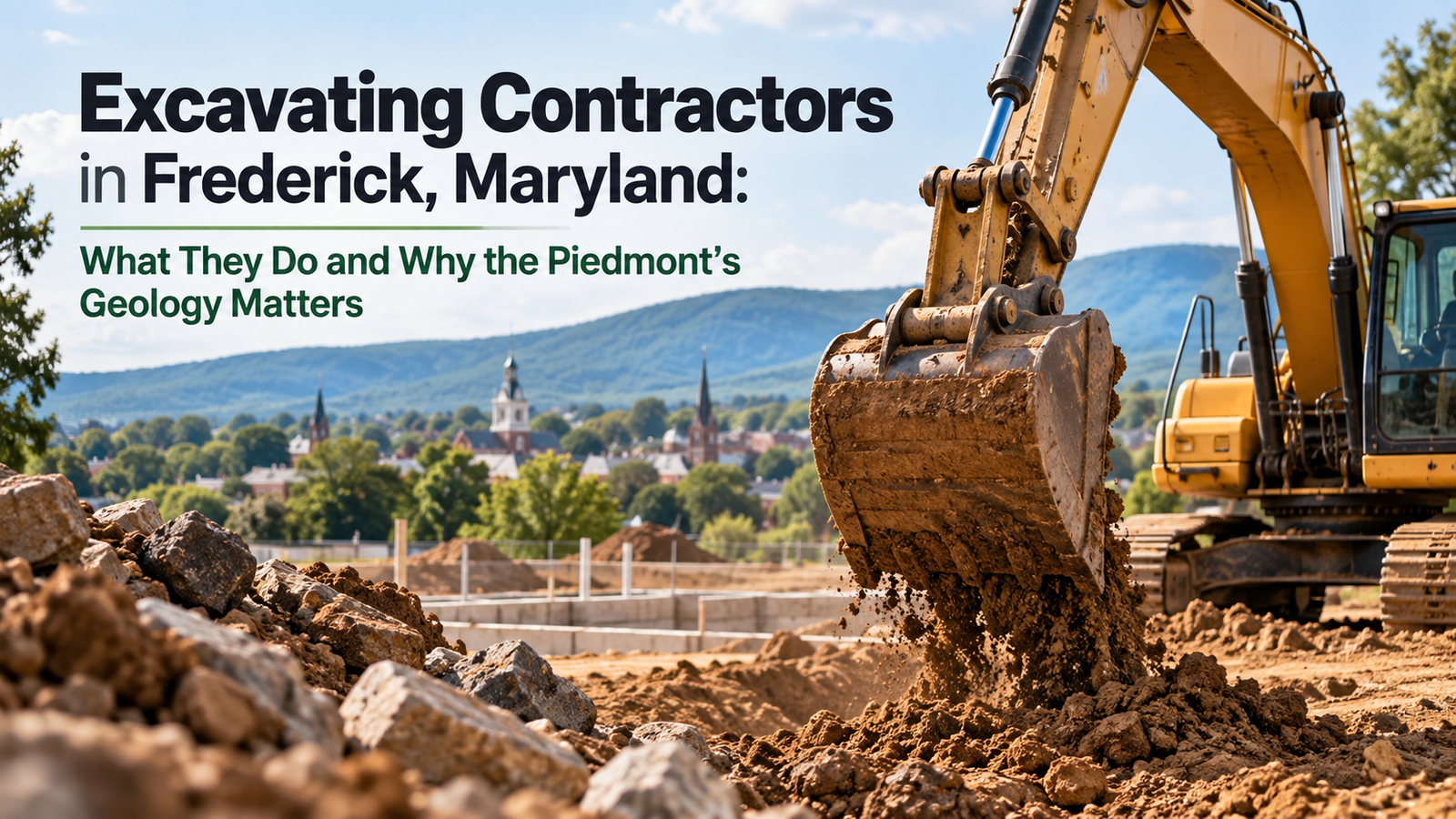
Frederick County sits at the physiographic transition between the Blue Ridge Mountains to the west and the Maryland Piedmont the rolling, geologically diverse region that extends eastward toward the Coastal Plain. This transitional geology, combined with the county’s active development market and the regulatory requirements that govern ground disturbance in Maryland’s Chesapeake Bay watershed, makes excavating work in Frederick more geologically varied and environmentally regulated than excavating in many other parts of the country. Understanding what Excavating Contractor Frederick provide in Frederick, how the local geology and soil conditions affect excavation work, and what Maryland’s environmental regulations require is essential background for any Frederick property owner planning a project that involves moving earth.
What Excavating Contractors Do
An excavating contractor specializes in the controlled movement of soil, rock, and subsurface material removing it, relocating it, or reshaping it to prepare a site for a specific use. This is foundational work that precedes almost every type of construction: before a foundation is poured, before a utility is installed, before a road is built, before a pond is dug, or before a building site is graded and shaped for drainage, an excavating contractor has prepared the ground. Excavating contractors are distinctly different from demolition contractors (who remove structures) and paving contractors (who surface prepared ground), though on many Frederick projects, all three scopes are managed by the same full-service contractor.
Foundation excavation creates the precise void in the ground into which a building’s foundation is placed. The excavation must match the foundation design’s specified depth, width, and bearing conditions. In Frederick County, where foundation types range from basement foundations (common in the established residential neighborhoods of the city) to crawl space foundations and slab-on-grade foundations (more common in newer construction), the excavation scope varies substantially by project. Basement excavation removing soil to a depth of eight to ten feet below grade generates the largest volume of excavated material of any residential foundation type and requires careful planning for where that material will go.
Utility trenching creates the narrow excavations through which underground utilities travel water supply lines, sanitary sewer pipes, storm drain pipes, gas mains, electrical conduits, and communications cables. Every property connected to municipal services has underground utility lines that were installed by an excavating contractor, and every time those lines need to be repaired, replaced, or newly installed, an excavating contractor returns. Frederick City and Frederick County have utility infrastructure in various states of age and condition, generating regular demand for utility trench excavation.
Site grading shapes the surface of the land to achieve the elevations, slopes, and drainage patterns required by a development project. In Frederick County, where the Piedmont’s rolling terrain frequently presents significant grade changes across a development site, grading is a major undertaking on many projects. The grading plan produced by a civil engineer establishes the cut-and-fill balance that minimizes material hauling while achieving the drainage and access grades required for the project.
Pond and drainage feature excavation creates the water management infrastructure that is both practically necessary and environmentally regulated throughout Frederick County. Farm ponds that serve agricultural water management, stormwater detention ponds required by development, drainage channels that route surface water away from structures, and the various water features that appear in residential landscape design all require excavating contractor expertise to construct correctly and durably.
Frederick County’s Geology and Its Effect on Excavation Work
Frederick County’s position at the physiographic transition between the Blue Ridge and the Piedmont creates a geologically varied landscape that experienced excavating contractors navigate differently across different parts of the county. The specific geology of a site has direct implications for how excavation is conducted, what equipment is needed, what the excavated material’s characteristics are, and what the subgrade conditions will be for whatever structure or feature is being built.
The Frederick Valley the broad lowland that runs roughly north-south through the center of Frederick County, hosting the city of Frederick and major transportation corridors is underlain by limestone, dolomite, and associated carbonate rocks of the Frederick Valley Limestone. These rocks are prone to dissolution by groundwater, which over geologic time has created karst features caves, sinkholes, and subsurface voids that can be encountered unexpectedly during excavation. Karst conditions in the Frederick Valley require specific attention from excavating contractors and geotechnical engineers: a sinkhole or void encountered during excavation must be properly assessed and addressed before foundation construction can proceed.
East of the Frederick Valley, the Piedmont geology transitions to the metavolcanic and metasedimentary rocks of the Triassic basin and older Piedmont basement, which weather to the red and brown clay soils characteristic of this part of Maryland. These clay-heavy soils expand when wet and shrink when dry, a behavior called shrink-swell that creates differential movement in foundations and pavements built on them. Excavating contractors in Frederick who are working in clay-heavy soils understand that subgrade preparation must account for this behavior proper moisture conditioning of the clay before compaction, and in some cases lime stabilization, are standard practices for improving clay subgrade performance.
The Blue Ridge geology in the western portions of Frederick County features metabasalt, phyllite, and other hard rock formations that are significantly more challenging to excavate than the softer soils of the valley and Piedmont. Rock encountered during excavation may require hydraulic breaking with a hammer attachment or, in extreme cases, controlled blasting under Maryland Department of Labor, Licensing and Regulation permits. Excavating contractors experienced in western Frederick County work have established protocols for identifying rock encounters early in the excavation process and adjusting their approach accordingly.
Maryland’s Environmental Regulations for Frederick Excavation Projects
Maryland’s position in the Chesapeake Bay watershed creates a regulatory environment for ground disturbance that is among the most comprehensive in the Mid-Atlantic region. Several Maryland regulatory programs directly affect excavating work in Frederick County.
Maryland’s Stormwater Management Program requires that development projects in Frederick County control stormwater runoff to prevent increased flooding and water quality impairment of streams and the Chesapeake Bay. For excavation projects above certain size thresholds, a stormwater management plan approved by Frederick County’s Department of Public Works is required. This plan specifies how runoff will be managed both during construction (temporary sediment control) and after construction is complete (permanent stormwater facilities).
Maryland’s Sediment Control Regulations (COMAR 26.17.01) require that any land disturbance greater than 5,000 square feet or involving more than 100 cubic yards of material have an approved sediment control plan. For excavating projects in Frederick County, this means silt fence, sediment traps, construction entrances, and other best management practices must be installed and maintained throughout the excavation period to prevent sediment from leaving the site and entering Frederick’s streams and waterways.
Maryland One Call (Miss Utility) the state’s underground utility notification system must be contacted at least two business days before any excavation in Maryland begins. This notification, made by calling 811, triggers the marking of underground utilities in the planned excavation area, preventing the costly and sometimes dangerous accidental strike of buried gas lines, water mains, electrical cables, and telecommunications infrastructure.
Common Questions About Excavating Contractors in Frederick
What does a geotechnical soil report tell an excavating contractor? A geotechnical investigation (soil boring and testing performed by a licensed geotechnical engineer) provides information about subsurface soil types, bearing capacity, groundwater depth, and any problematic conditions like karst features or compressible organic material. This information guides the excavating contractor’s approach to foundation excavation and subgrade preparation. For significant projects in the Frederick Valley limestone zone, geotechnical investigation before excavation begins is strongly recommended.
How is excess excavated material managed in Frederick County? Excavated soil and rock from Frederick projects either stays on site (used as fill in lower areas to balance the cut-fill equation), is transferred to another construction project that needs fill, or is disposed of at permitted fill sites or solid waste facilities. Clean soil from excavation is a recyclable material that many sites need coordinating with the contractor about where excess material will go is an important pre-excavation planning step.
Does excavation near a Frederick County stream or wetland require special permits? Yes. Excavation or grading within or adjacent to regulated streams, wetlands, or floodplains in Maryland may require a Waterway Construction Permit from the Maryland Department of the Environment and potentially a US Army Corps of Engineers Section 404 permit. The presence of these features near a planned excavation should be identified early in the project planning process, before permit applications are submitted.